Yeah, it happens, and happens often. And often those mismatches end up with dogs in, or back in shelters from harried owners who couldn’t handle the physical onslaught of their mismatched dog.
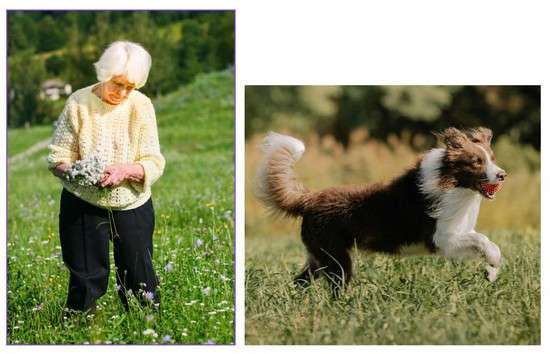
But it’s always the dog that pays grievously when those events take place.
Adolescent and genetically high energy dogs, are often not a good match for primarily sedentary people in their 60s – 80s.
In general someone in their 70s, without being very physically active in either strength or conditioning work, is not often a good match for an 8 month old Border Collie. Or a 10 month old Golden Retriever, or a 7 month old Australian Shepherd.
Of course that can be the case for much younger people who simply get those without realizing what they are committing to.
NOTE: None of this is to imply that age alone is a determining factor in being able to manage and effectively work with an active working breed dog. At this writing, I am 70 years old, work with dozens of dogs of all sizes, ages, breeds monthly, in addition to running my own big robust animals through the woods regularly.
But this is about cases where the physical effort to keep these dogs is beyond the apparent capability of their humans, whatever their age.
So, without the emotional, and physical disaster that is abandonment to a shelter, what can be done by older adults, to enable them to keep and manage their young, turbo-charged canines?
Well, no matter the physical condition of the humans, the exercise requirements of these and other working dogs does not diminish.
Training starts here, with leash work, and obedience training working together.
Knowing this condition exists, any trainer should be ready to modify their training course, to include long leash walking. That means teaching the owner to walk what is normally a wild, hard pulling dog, on a 20 foot slip leash.
Yeah, you saw that right. A 20 foot leash.
That often sounds insane when the owner can’t begin to handle the dog on a typical 6 foot leash.
But that’s where a competent trainer can guide the owner through the best of both worlds.
The ability to allow the dog to move freely and quickly, to actively meet their exercise needs; while allowing the owner to control the proximity and direction of the dog without as much struggle.
Book your training course. We’ll work it out. You’ll be fine with your energetic, turbo charged canine.
Here’s to your best life with your dog.
~Mark Rogers